The 179-year-old Myrte House in Wädenswil was renovated in preparation for the transformation of the industrial MEWA site. The project is closely linked to the development of its surroundings, marking the beginning of the upcoming construction on the MEWA site. The building now features a public ground floor, office spaces on the first and attic floors, and a loft-style residential unit.

Initial Situation
In 2022, the renovation and repurposing of Myrte House was decided as the first phase of the new MEWA site development. The mixed-use residential and commercial project aims to enhance the neighborhood’s livability and quality. Once completed, the building will serve as a communication hub for the site’s ongoing development. The office spaces on the upper floor will be used as a construction office during the transformation of the MEWA site. Myrte House is not only part of the collective memory but also serves as a compass for the city’s future.

Design Concept
Residents of Wädenswil remember the historic building before its renovation. Many local stories are associated with Myrte House, making it a key part of the city’s collective memory. It once housed a grocery store and a men’s tailor shop. As architects, preserving as much of the historic substance as possible was essential. Although no longer under heritage protection, the building retains stories and memories, making it a local cultural asset that is now being carefully transformed for the future.

The public ground floor remains and will serve as an exhibition space, informing residents and stakeholders about the conversion of the former industrial site into residential and commercial areas. The first floor will serve as a construction office during the MEWA site’s development, while the second floor remains a refined residential space. By removing part of the existing top-floor ceiling, a loft-style living area with high ceilings is created. This opening enhances the spatial connection between floors, easing the previously confined layout. It also establishes visual links between the public ground floor and the office spaces on the first floor. The new material concept is inspired by the metal goods once produced on the MEWA site, paying tribute to its industrial heritage.

Construction & Renovation
Although the building was externally well-preserved, a structural analysis revealed the need for reinforcements. Targeted reinforcement with reinforced concrete was implemented, and seismic measuring points were added. Additionally, floor and roof insulation were improved for energy efficiency. Where ceiling height allowed, old radiators were replaced with underfloor heating. The existing gas heating system is temporarily retained, but in the future, Myrte House and all new buildings on the MEWA site will be heated using geothermal energy. Selected wooden beams were left exposed as witnesses of the past.

The interior design follows a minimalist approach, using a limited palette of materials and colors: oak wood, exposed concrete, glass, and white surfaces create a simple yet functional interior.
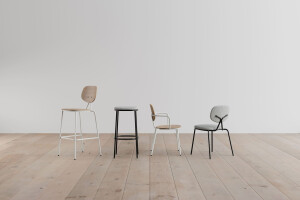
The stucco facade is being renewed and painted green, a color commonly used in factory interiors in the past. Perforated aluminum shutters replace the original wooden shutters, paying homage to the Landi chair, designed by Hans Coray in 1935.

History
According to insurance records, Myrte House was built in 1845 by Heinrich Baumann. It was one of the first buildings constructed along Zugerstrasse after its expansion in 1841. Originally located on rural land outside the village, it now stands on a busy urban street surrounded by residential and commercial buildings. Since most early 19th-century townhouses have been demolished or replaced, Myrte House remains one of the last local architectural witnesses of that era.
Additionally, its simple neoclassical hipped-roof design is unusual for a farmhouse, representing the transition from rural to urban residential architecture.

In 1984, the house was added to the local heritage inventory by the AOI (Association for Urban Conservation and Inventory). However, in 2010, Blattmann Metal Goods Factory requested its removal from the heritage protection list. A review by Zurich’s Monuments Commission determined that due to numerous structural alterations over time, the building was no longer considered historically significant. Consequently, in 2011, Myrte House was officially removed from the heritage protection list.